

NEPTUN
Electronic chesmounted Rebreather
Nothing has changed, and everything is changing.

Breathe effortlessly
The breathing circuit remains the same, as does its breathing performance.

Keep your habits
Keep your configuration, it attaches to your belly

Explore hands-free
The NGC manages the regulation of your PpO2 for you


Numbers that speak volumes
The NEPTUN continues the principles of the M3S rebreather with its three key features.
it is small,
it is light,
it is chestmounted.
These features allow it to adapt to your configuration, your needs, your desires, and your travels around the world.
Whether you dive locally or during your travel it will accompany you wherever you dive.
It is small
The NEPTUN retains the lightness, compactness, and simplicity of the TRITON. We wanted to bring an electronic version to recyclers. That's why, since 2019, we've been working on the NGC electronics. The power of the NGC, divided into five assemblies, has allowed us to develop a clean operation for the NEPTUN.
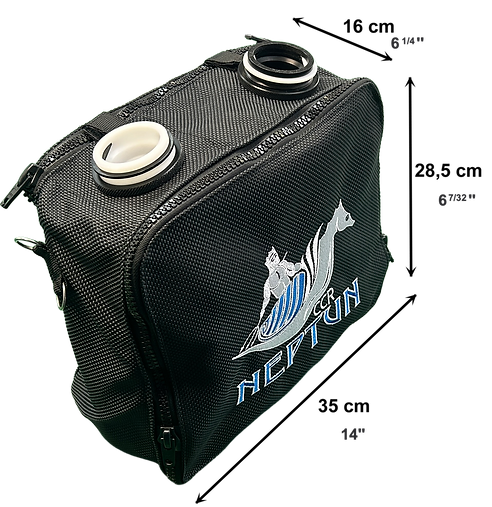

The NGC can do all of this
New Generation Computer - NGC
The NEPTUN retains the lightness, compactness, and simplicity of the TRITON. We wanted to bring an electronic version to recyclers. That's why, since 2019, we've been working on the NGC electronics. The power of the NGC, divided into five assemblies, has allowed us to develop a clean operation for the NEPTUN.


Just ask, it does it
The regulation module, eGB.
The oxygen passing through the eGB flows into the ADV body (downstream of the expansion body), as does the oxygen coming from the oxygen valve. The eGB being connected to the medium-pressure oxygen network of the rebreather, it operates under a medium pressure of 10 ± 1 bar relative.
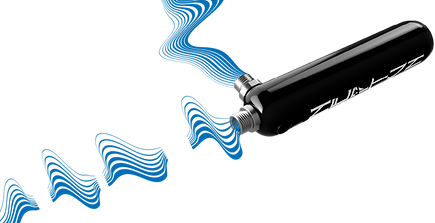

Optical fiber allows data to be exchanged between the NGC central unit (rebreather intelligence) and the eGB (actuator). Using optical fiber allows the eGB to be disconnected without the risk of water entering the module (including during a dive), which could affect the module's proper operation. The central unit sends the opening instruction to the solenoid and receives the voltage from the eGB's power supply battery.
An adaptive rebreather, aCCR.
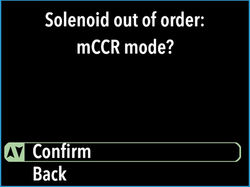
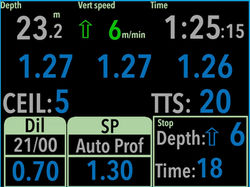
The NGC for the NEPTUN is no longer a simple display and active alarm element, but rather the automatic control of PpO₂. The display allows PpO₂ management by:
-
choosing one of the 4 PpO₂ control modes;
-
manual,
-
autoProf,
-
autoSmart,
-
mCCR,
-
-
adjusting the 2 Set Point values (high and low),
-
adjusting the 2 depth setpoint values for AutoProf.




No stress, ...
…, it decompresses
It manages the gases
Diluent
The NGC offers the ability to program five diluent gases (O₂ / helium).
The first percentage indicates the O₂ content of the mixture. The second percentage (after the "/") represents the helium content of the mixture.
You can configure the active diluent of the rebreather, which will be used to calculate decompression before and during the dive.
Bailout
The NGC offers the ability to program five bailout gases (O₂ / Helium).
The first percentage indicates the O₂ content of the gas mixture. The 2nd percentage (after the “/”) represents the helium portion of the mixture.
You have the ability to modify the active bailout as well as change the values defining the bailout during the dive.


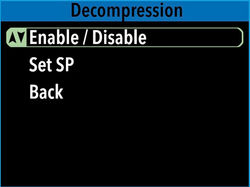
Decompression models
The NGC is also a dive computer. M3S has opted for diversity by offering a standard decompression model and the option of another. These two decompression models are:
-
The Bülhmann ZHL-16C decompression model with factor gradients is standard.
-
The BZH L16C decompression model is optional.
Bühlmann ZHL-16c
As standard, M3S has chosen the Bühlmann decompression algorithm, which is a theoretical mathematical model describing how inert gases enter and exit the human body when the ambient pressure changes.
BZH L16C
As an option, M3S offers the possibility of the BZH L16C. This model allows you to optimize decompression times, while controlling the risks of decompression sickness during deep dives.





It's all about choosing the right one…


NEPTUN Standard
You are an occasional diver, on the weekend, or you have the possibility of reinflating the tank after each dive.
1,5 L aluminium


M - 2,2 kg of lime

NGC
or
NGC + Petrel 3
or
NGC + Nerd 2

NEPTUN expedition
You are a very regular diver, speleologist, technical diver doing long dives or in very cold waters.
2,5 L steel
L - 3 kg of lime
NGC
or
NGC + Petrel 3
or
NGC + Nerd 2
NEPTUN standard or expedition
No matter your standard or expedition NEPTUN, you want to have redundancy on the NGC with Shearwater products.
1,5 L or 2,5 L
M or L
NGC
or
NGC + Petrel 3
or
NGC + Nerd 2